


Page 66 - An Overview of Penghu
P. 66
Drinking water

                 It is difficult to obtain quality drinking water due to dry weather and rocky terrains unfavorable for the growth
            of  vegetation,  which  is  also  the  result  of  salty  seasonal  winds  in  winter  that  cause  plants  to  wither. Available
            drinking water, in contrast, is high in chlorine. The situation is especially dire during the dry season, as the lack of
            rainfall causes wells to dry up, and people are forced to use dirty water at the bottom of wells instead. Therefore, the
            government must build more wells in the Prefecture.


            Water Infrastructure in Magong

                 Magong has burgeoning civilian and military activities, as it is the place where the Guard District of the Navy,
            Army  Fortress  Headquarters,  and  Heavy Artillery  Regiment  were  stationed. The  existing  wells  and  five  Kazusa
            wells were no longer sufficient, arousing anxiety especially during emergencies or a spike in population growth.
            Hence, there is an imperative need to build new water infrastructure.

                 The construction of Magong's water infrastructure initiated in June 1927 was completed in October 1929. It
            started providing water to the town at the end of 1930, solving the problem that had long beset Magong. However,
            water is only available for an hour per day due to a low flow rate, which could only provide one-seventh of the
            expected water supply. With the flow rate in decline, the prefectural government asked the Government-General to
            find a solution to the problem with urgency.


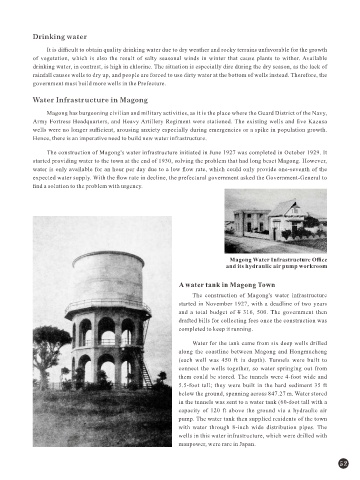
                                                                                Magong Water Infrastructure Office
                                                                               and its hydraulic air pump workroom


                                                              A water tank in Magong Town

                                                                   The  construction  of  Magong's  water  infrastructure
                                                              started  in  November  1927,  with  a  deadline  of  two  years
                                                              and  a  total  budget  of  ¥  316,  500.  The  government  then
                                                              drafted bills for collecting fees once the construction was
                                                              completed to keep it running.

                                                                   Water for the tank came from six deep wells drilled
                                                              along  the  coastline  between  Magong  and  Hongmucheng
                                                              (each  well  was  450  ft  in  depth).  Tunnels  were  built  to
                                                              connect  the  wells  together,  so  water  springing  out  from
                                                              them  could  be  stored. The  tunnels  were  4-foot  wide  and
                                                              5.5-foot  tall;  they  were  built  in  the  hard  sediment  35  ft
                                                              below the ground, spanning across 847.27 m. Water stored
                                                              in the tunnels was sent to a water tank (60-foot tall with a
                                                              capacity  of  120  ft  above  the  ground  via  a  hydraulic  air
                                                              pump. The water tank then supplied residents of the town
                                                              with  water  through  8-inch  wide  distribution  pipes.  The
                                                              wells in this water infrastructure, which were drilled with
                                                              manpower, were rare in Japan.

                                                                                                                      52

