


Page 81 - An Overview of Penghu
P. 81
The First Sino-Japanese War and Penghu

                 The Donghak Rebellion in May 1894 triggered the First Sino-Japanese War. On July 23rd of the same year, the
            Qing  army  fired  at  the  Japanese  army  from  Seoul,  while  their  Japanese  counterparts  sank  a  Qing  warship  near
            Pungdo as revenge. In August, the two nations declared war on each other.

                 News of the conflict had already been passed on to Taiwan in haste in May; Taiwanese people were severely
            rattled. The governor at that time was Shao You-lian, who put his focus entirely on Penghu. He assigned four militia
            battalions  to  General  Zhou  Zhen-bang  and  an  artillery  battalion  to  General  Liu  Xi-hou  to  defend  the  Island.  In
            September of the same year, Shao left Taiwan because he was assigned as the governor of Hubei and Hunan. After
            hearing unfavorable news from the north, his successor Tang Jing-song set up five extra battalions for the defense in
            Penghu and Tamsui. Commander Liu Yong-fu also recruited 5,000 soldiers to set up a district watch force. The
            group was responsible for organizing militias and collecting donations; its director, Taipei Governor Guan Yuan-
            shan,  had  to  report  directly  to  Tang  Jing-song.  Knowing  that  taking  down  Penghu  was  the  shortcut  to  occupy
            Taiwan, the imperial army moved into the second phase of its plan. On March 23, 1895, Commander Itō led the First
            Fleet and bombarded the Penghu Fort, to cover for the disembarkation of the Japanese army. Meanwhile, a mixed
            brigade led by Colonel Hishijima reached the southern bay of Bazhao Island by two royal ships, Kagoshimamaru
            and Shibatamaru, and then disembarked from Lizhengjiao of Lintouao Village in southeast Penghu. On the same
            day, the troops advanced into the center of Penghu Island and attacked the Gongbei Fort, defeating the Qing troops
            and occupied the Magong Castle. Since this operation happened three months before Japan's takeover of Taiwan,
            we can call those soldiers pioneers in terms of their occupation of Taiwan.

                   After  sending  the  surrendered  Qing  soldiers  back  to  their  country,  the  Japanese  empire  assigned  Major
            General Tanaka Tsuna as the governor of Penghu Archipelago, imposing martial laws here to pacify its residents.
            On May 10th, the empire assigned Admiral Kabayama as the first Governor-General of Taiwan. Before he embarked
            for the island nation on May 21st, Kabayama drafted the Temporary Provisions of the Governor-General of Taiwan
            in Hiroshima, starting Japan's stratocratic rule over Taiwan through a civil affairs office, an army office, and a naval
            office.  In  June  of  the  next  year,  he  issued  the  Temporary  Provisions  of  Local  Governments  and  set  up  Taipei
            Prefecture, Taiwan Prefecture, Tainan Prefecture, and Penghu Island Prefecture.

                  It is common to find stratocratic governments in newly-conquered lands. Even if there is one that appears to
            be a civil government, it is still a stratocratic administration down to its core. A true civil government did not appear
            in Taiwan until April 1, 1896 when an edict concerning local government organization was announced.


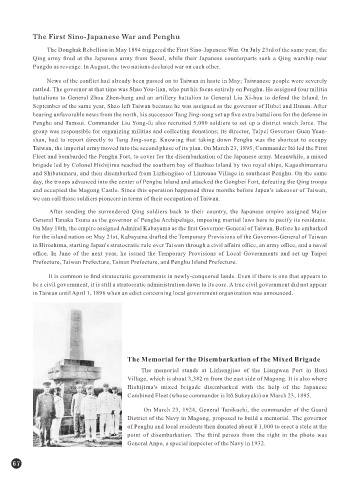
                                             The Memorial for the Disembarkation of the Mixed Brigade

                                                  The  memorial  stands  at  Lizhengjiao  of  the  Liangwen  Port  in  Huxi
                                             Village, which is about 3,382 m from the east side of Magong. It is also where
                                             Hishijima's  mixed  brigade  disembarked  with  the  help  of  the  Japanese
                                             Combined Fleet (whose commander is Itō Sukeyuki) on March 23, 1895.

                                                    On  March  23,  1924,  General Tanikuchi,  the  commander  of  the  Guard
                                             District of the Navy in Magong, proposed to build a memorial. The governor
                                             of Penghu and local residents then donated about ¥ 1,000 to erect a stele at the
                                             point  of  disembarkation.  The  third  person  from  the  right  in  the  photo  was
                                             General Anpo, a special inspector of the Navy in 1932.


     67

