


Page 79 - An Overview of Penghu
P. 79
Although locking down Taiwan and the Penghu Archipelago was a great feat, the French did not
            seem to have done it thoroughly enough, as a British ferry named Weberen continued to sail back and
            forth between China and Taiwan; it still managed to carry 650 Qing soldiers within four hours during its
            last sailing. Noticing the loopholes, Admiral Courbet extended the lockdown to the sea around Penghu
            and  reinforced  the  defense.  An  extra  35  ships  were  deployed  to  the  lockdown  area,  including  four
            ironclad warships, 16 patrol ships, seven gunboats, two dispatch boats, two transportation boats, and two
            torpedo  boats. A  British  ferry  named  Pingan  attempted  to  carry  500  to  600  soldiers  from  Xiamen  to
            Taiwan at the end of April, but was caught at sea near Taiwan and was deported to Penghu. Its captain and
            Qing soldiers were later sent to Saigon. From the incident, it is not difficult to see how hard a lockdown is
            to enforce. Meanwhile, antiwar ideologies were brewing back in France, and the French army lost the
            manifesto to fight as a result. Besides, the number of soldiers getting sick due to turbulent waves and bad
            weather at Keelung Port and Tamsui Port was also rising, forcing the dejected Admiral Courbet to plan a
            withdrawal to Penghu and wait for orders from the French government.

                 On  February  13,  1885,  Courbet  led  seven  ships  to  invade  Penghu  from  Fengguiwei  Peninsula,
            landed Yuanding Bay in the south. The French army occupied Magong and established its base there.
            Unfortunately, a vicious plague started spreading in the army, causing more and more soldiers to die, and
            Courbet himself also perished in Magong due to the disease. Not long after, the government in France
            had changed hands, and the new government decided to stop fighting. A deal was reached on May 8th,
            and Taiwan was liberated.


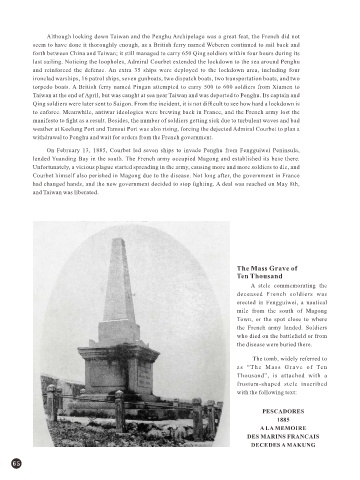
                                                                                  The Mass Grave of
                                                                                  Ten Thousand

                                                                                       A  stele  commemorating  the
                                                                                  deceased  French  soldiers  was
                                                                                  erected  in  Fengguiwei,  a  nautical
                                                                                  mile  from  the  south  of  Magong
                                                                                  Town,  or  the  spot  close  to  where
                                                                                  the  French  army  landed.  Soldiers
                                                                                  who died on the battlefield or from
                                                                                  the disease were buried there.

                                                                                        The tomb, widely referred to
                                                                                  a s  “ T h e  M a s s  G r a v e  o f  Te n
                                                                                  Thousand”,  is  attached  with  a
                                                                                  frustum-shaped  stele  inscribed
                                                                                  with the following text:


     65

