


Page 43 - An Overview of Penghu
P. 43
Farmers  also  came  to  realize  the  excellent  effects  of  the  fences,  as  they  asked  for
            permission  to  set  up  windbreaks  in  areas  outside  the  basic  windbreak  forests  and  fields  not
            protected by windbreaks, especially vegetable fields. There were even people who voluntarily
            built windbreak fences without claiming subsidies from the government.

            Ÿ Nursery

                 The  term  nursery  here  refers  to  those  kept  by  civilians  that  were  turned  into  special
            nurseries for growing plants used for windbreaks. In 1927, new nurseries were created for plants
            that were used for desertification-prevention windbreaks on coastlines and protection forests.
            Nurseries  with  an  area  of  33,058  m2  were  built  in  Huxi  of  Huxi  Village,  where  1.3  million
            seedlings were cultivated every year. Furthermore, seeing the need to build more windbreaks,
            the government rented 23,140.6 m2 of land from people and built a nursery, growing 900,000
            Australian pine tree seedlings every year since October 1928, to build windbreaks that protected
            fields in Daguoye. Another 1.6 million seedlings for windbreaks in Daguoye were cultivated in
            the  nursery  in  1930,  while  an  extra  500,000  for  desertification-prevention  windbreaks  on
            coastlines were grown in the Huxi Plant Nursery. The government also asked people to cultivate
            400,000 seedlings for basic windbreaks at the Watong Plant Nursery in Baisha Village. These
            are all efforts the government put in to meet the developmental needs of Penghu's forestry.


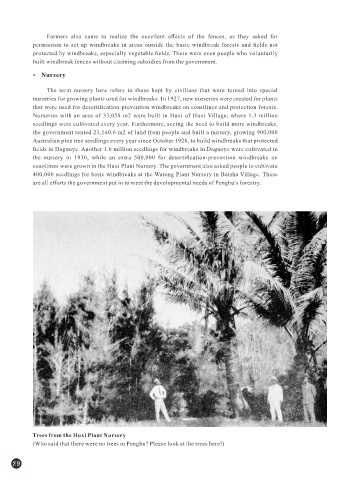
            Trees from the Huxi Plant Nursery
            (Who said that there were no trees in Penghu? Please look at the trees here!)


     29

