


Page 39 - An Overview of Penghu
P. 39
Agriculture

            Ÿ Farmers:


                 As of the end of 1930, there were 11,181 households, with a
            total  of  63,997  people  in  the  Prefecture,  among  which  7,829
            households,  or  44,482  people,  were  engaged  in  agriculture.  In
            other words, almost 70% of the population in the Prefecture was
            farmers.

            Ÿ Fields:

                 There were neither irrigation infrastructure nor paddy fields
            in  the  Prefecture.  The  total  area  of  Hatake,  or  fields,  was  over
            7,530  hectares,  which  means  that  each  person  owns  only  0.11
            hectares  of  land  on  average.  This  number  shows  a  shortage  of
            farmland. Arable lands have all been developed, leaving farmers
            with no more land to farm.


            Ÿ Agricultural policies:

                 Before the Japanese takeover, Taiwanese people caused the
            land  to  gradually  become  infertile  because  they  did  not  pay
            attention  to  improve  breeds  and  manuring,  leaving  the  job  to
            Mother Nature. In 1910, the government established the Penghu
            Prefecture Farmers' Association and immediately engaged in plant
            breeding  by  selecting  excellent  seeds  from  Taiwan  and  Japan.
            Starting  from  vegetables  first,  the  Association  moved  on  to
            improve  sweet  potatoes,  peanuts,  sorghum,  and  foxtail  millet
            through  a  series  of  adaptability  tests;  they  then  promoted  the
            excellent  breeds  they  selected  and  encouraged  people  to  grow
            them. Although  the  policy  produced  good  outcomes,  it  was  still
            not  enough  to  make  the  Prefecture  self-sufficient.  To  increase
            production, the government has to address core issues first, such
            as  removing  the  obstacles  caused  by  the  weather  and  improving
            farming  techniques  by  building  windbreaks  made  of  straw  and
            clay and planting windbreak forests that protect fields.

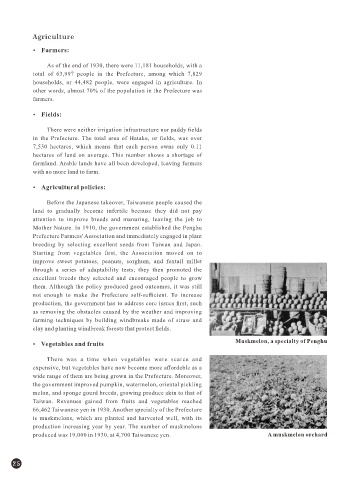
                                                                                  Muskmelon, a specialty of Penghu
            Ÿ Vegetables and fruits
                 There  was  a  time  when  vegetables  were  scarce  and
            expensive, but vegetables have now become more affordable as a
            wide range of them are being grown in the Prefecture. Moreover,
            the government improved pumpkin, watermelon, oriental pickling
            melon, and sponge gourd breeds, growing produce akin to that of
            Taiwan.  Revenues  gained  from  fruits  and  vegetables  reached
            66,462 Taiwanese yen in 1930. Another specialty of the Prefecture
            is  muskmelons,  which  are  planted  and  harvested  well,  with  its
            production  increasing  year  by  year. The  number  of  muskmelons
            produced was 19,000 in 1930, at 4,700 Taiwanese yen.                             A muskmelon orchard


     25

