


Page 128 - An Overview of Penghu
P. 128
Historical sites


           |Wenshi Academy|


                 Ripples are extending across the clear water of Wenao Bay, with flocks of birds flying over or resting on it.
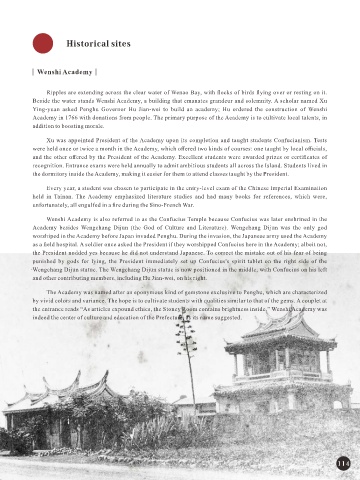
            Beside the water stands Wenshi Academy, a building that emanates grandeur and solemnity. A scholar named Xu
            Ying-yuan  asked  Penghu  Governor  Hu  Jian-wei  to  build  an  academy;  Hu  ordered  the  construction  of  Wenshi
            Academy in 1766 with donations from people. The primary purpose of the Academy is to cultivate local talents, in
            addition to boosting morale.


                 Xu  was  appointed  President  of  the Academy  upon  its  completion  and  taught  students  Confucianism. Tests
            were held once or twice a month in the Academy, which offered two kinds of courses: one taught by local officials,
            and the other offered by the President of the Academy. Excellent students were awarded prizes or certificates of
            recognition. Entrance exams were held annually to admit ambitious students all across the Island. Students lived in
            the dormitory inside the Academy, making it easier for them to attend classes taught by the President.

                 Every year, a student was chosen to participate in the entry-level exam of the Chinese Imperial Examination
            held  in  Tainan.  The  Academy  emphasized  literature  studies  and  had  many  books  for  references,  which  were,
            unfortunately, all engulfed in a fire during the Sino-French War.

                 Wenshi Academy is also referred to as the Confucius Temple because Confucius was later enshrined in the
            Academy  besides  Wengchang  Dijun  (the  God  of  Culture  and  Literature).  Wengchang  Dijun  was  the  only  god
            worshiped in the Academy before Japan invaded Penghu. During the invasion, the Japanese army used the Academy
            as a field hospital. A soldier once asked the President if they worshipped Confucius here in the Academy; albeit not,
            the President nodded yes because he did not understand Japanese. To correct the mistake out of his fear of being
            punished  by  gods  for  lying,  the  President  immediately  set  up  Confucius's  spirit  tablet  on  the  right  side  of  the
            Wengchang Dijun statue. The Wengchang Dijun statue is now positioned in the middle, with Confucius on his left
            and other contributing members, including Hu Jian-wei, on his right.

                 The Academy was named after an eponymous kind of gemstone exclusive to Penghu, which are characterized
            by vivid colors and variance. The hope is to cultivate students with qualities similar to that of the gems. A couplet at
            the entrance reads “As articles expound ethics, the Stoney Room contains brightness inside.” Wenshi Academy was
            indeed the center of culture and education of the Prefecture, as its name suggested.


                                                                                                                     114

