


Page 38 - 澎湖海洋地質公園-文化與旅遊篇
P. 38
澎湖海洋地質公園 PENGHU MARINE GEOPARK                               文化與旅遊篇         Culture & Travel Volume


 民生用品
 在澎湖人的生活裡,玄武岩亦有密切的關係,石  利生長的防風農地。菜宅周圍疊砌的石牆稱為「宅
 磨、石臼、洗衣石盆、豬槽等,早期船上壓艙石、  岸」,為抵擋強勁的東北季風,大多以北牆最高,
 石錨等,甚至史前的網墜也是玄武岩所製成。  大約1.5公尺至2.5公尺;東、西牆次之,高約1.5
 公尺至1.8公尺之間;南牆最低,大多不超過1公
 石磨、石臼是早期居民磨搗高梁、粟或做年糕所不能  尺。有些菜宅因應東北季風及現有遮蔽物(如臨防
 或缺的用具。澎湖名聞遐邇的野生紫菜,則是以玄  風林)只砌東北側之石牆。石牆通常以石或玄武岩
 武岩為聚生母體;玄武岩洗衣盆是洗滌衣物專用;豬  等當地材料為建材加以砌築,砌築圍牆的旱作農地
 槽及食槽等則養豬、牛、羊、雞、鴨的重要器具。其  如果筆筆相連,遠觀則狀似蜂巢,極為壯觀。每年
 他諸如鋪橋造路或是築漁港、碼頭、做石碑、田地地  10月秋風一起,  旱田(  澎湖稱為「園」)裡的雜
 界、田埂,似乎也少不了它,甚至水井的井口、內部  糧都已收完,大地就一片枯黃,只有防風的宅內還
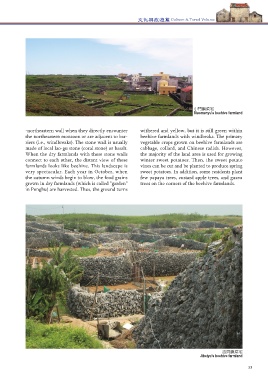
 井欄等,也都是以玄武岩為主要材料。                                                                     小門嶼菜宅
 有點點綠意。菜宅裡的蔬果以甘藍、芥藍、蘿蔔為                                                                Siaomenyu's beehive farmland
 菜宅可說是澎湖文化發展的搖籃,在澎湖的鄉下處  主,但是大部份的面積都用來種冬作蕃薯(俗稱
 處可見,其特殊性大不同於台灣本島的農地。澎湖  「栽母」),以便到翌年3月摘下藤來插植春作蕃
 的「菜宅」又稱「宅內」,是一種2至4面砌石牆,  薯。此外,也有人在菜宅一隅種植少量的木瓜、釋  -northeastern wall when they directly encounter   withered and yellow, but it is still green within
 用來抵擋強勁的東北季風,使作物在冬天裡還能順  迦、番石榴等果樹。  the northeastern monsoon or are adjacent to bar-  beehive farmlands with windbeaks. The primary
            riers (i.e., windbreaks). The stone wall is usually   vegetable crops grown on beehive farmlands are
            made of local lao-gu stone (coral stone) or basalt.   cabbage, collard, and Chinese radish. However,
 Living Appliances  When the dry farmlands with these stone walls   the majority of the land area is used for growing
            connect to each other, the distant view of these
                                                               winter sweet potatoes. Then, the sweet potato
 Basalt is closely linked to the life of Penghu   Beehive farmlands are the cradle of Penghu’s   farmlands looks like beehive. This landscape is   vines can be cut and be planted to produce spring
 residents. The basalt was utilized to make stone   cultural development. They can be found every-  very spectacular. Each year in October, when   sweet potatoes. In addition, some residents plant
 miller, stone mortar, stone basin, pig trough, ship   where in the countryside of Penghu. They have   the autumn winds begin to blow, the food grains   few papaya trees, custard apple trees, and guava
 ballast stone and stone anchor in the early time,   quite different characteristics from the farmlands   grown in dry farmlands (which is called "garden"   trees on the corners of the beehive farmlands.
 and even prehistoric net sinker, etc.  in Taiwan Island. Penghu's "beehive farmland"   in Penghu) are harvested. Thus, the ground turns
 is also called "crop house." Beehive farmlands
 For the early Penghu residents, the basalt stone
 ~
 miller and stone mortar were necessary applianc-  have 2 4 sides of stone walls to withstand the
 es to pound and grind sorghum and millet. The   strong northeastern monsoon. Thus, they are
 basalt is inhabited by Penghu's well-known wild   windproof in which the crops can grow properly
 laver assemblage matrix. Basalt basin can be used   and survive hardship in winter. The name for the
 for washing clothes. Pig trough, feed trough,   surrounding walls of beehive farmlands is "crop
 etc. are important appliances to raise pigs, cows,   bank." For withstanding the strong northeastern
 lambs, chickens, and ducks. In addition, basalt   monsoon, among the four side walls, usually, the
 ~
 seems to be an essential construction material   northern wall is the tallest, about 1.5 2.5m tall,
 for building the bridge, road, fishing port, dock,   the eastern and western walls are the second-
 ~
 stone tablet, farm boundaries, and farm ridges.   tallest, about 1.5 1.8m tall, and the southern
 Moreover, it is the main material used for the   wall is the lowest, usually lower than 1m tall.
 mouth and wall of the well.   Some beehive farmlands have only one side wall-


                                                                                                    吉貝嶼菜宅
 石磨 Stone miller  石臼 Stone mortar                                                         Jibeiyu's beehive farmland

 32                                                                                                            33

